Geopolitical overflight risk is one of the most complex and consequential challenges in commercial aviation today. Addressing it effectively requires airlines, regulators, insurers, intelligence providers and legal experts to work from a shared understanding of a risk environment that is changing faster than most existing frameworks were designed for. Every two years, WORC™, the World Overflight Risk Conference, brings that community together to do exactly that. WORC2026, held in Malta on 21 and 22 April 2026, was the second edition of the conference, drawing over 200 participants from across the global aviation community for two days of sessions examining overflight risk, conflict zone decision-making and the frameworks the industry uses to manage both.
The regulatory and policy landscape
The conference opened with a keynote from Juan Carlos, the Secretary General of the International Civil Aviation Organization (ICAO), who addressed the structural shifts reshaping the risk environment. Sessions examined the current state of ICAO’s conflict zone guidance, including Doc 10084 and Doc 9554, the role of Assembly Resolution A42-4 in establishing global standards for airspace risk assessment and the progress of the Safer Skies Consultative Committee (SSCC) in the six years since the downing of Ukraine International Airlines flight PS752.
A dedicated keynote from ICAO’s Regional Director for Europe and North Atlantic, Nicholas Rallo, addressed how Contingency Coordination Teams (CCTs) function during active conflict and what the experience of the most recent Middle East crisis revealed about the mechanism’s capabilities and its limits.
Airline operations and conflict zone decision-making
A significant portion of the agenda was devoted to operational decision-making: how airlines assess conflict zone risk, how they communicate those assessments internally and what determines the quality of their response when airspace deteriorates rapidly.
Panellists from major commercial carriers discussed the practical realities of suspending and resuming operations near active conflict zones, including how safety gate criteria are defined, how crew confidence is built and maintained and how commercial pressure interacts with security-driven decision-making. The role of independent intelligence in supporting those decisions, as distinct from government advisories and industry consensus, received substantial attention across multiple sessions.
Risk assessment methodology
One of the conference’s most substantive threads examined how the industry measures risk and whether the tools most widely used are performing as well as operators believe. Sessions explored the limitations of ordinal risk assessment methods, the evidence base for probabilistic and quantitative alternatives and what meaningful mitigation effectiveness looks like in practice.
The discussion drew on academic research, quantitative decision science and applied experience from operators who have begun moving away from conventional risk matrix approaches toward more calibrated methodologies.
The financial case for better risk intelligence
A keynote examining the true cost of geopolitical risk in aviation brought a commercial and financial lens to what is often framed purely as a safety and security challenge. The session explored how geopolitical disruption translates into direct operational costs, including longer routings, increased fuel burn, diversions, crew positioning challenges, and asset exposure. It also examined how these costs can accumulate across an airline’s network over time and, in many cases, be avoided through earlier risk identification and more informed decision-making.
The keynote examined the relationship between access to verified, predictive intelligence and an operator’s ability to make routing decisions that reduce unnecessary fuel consumption. In an environment where fuel prices remain a significant source of financial pressure across the industry, the ability to avoid reactive rerouting carries a material and measurable operational saving.
GNSS interference and emerging threat vectors
Technical sessions addressed the growing challenge of Global Navigation Satellite System (GNSS) interference in conflict-adjacent airspace. Discussion covered the scale and distribution of jamming and spoofing activity, the ways in which interference interacts with other aircraft systems and the implications for operators flying routes where GNSS reliability can no longer be assumed.
Separate sessions examined the proliferation of advanced surface-to-air weapon systems to non-state actors and what that development means for the altitude-based assumptions underpinning current overflight risk frameworks.
Crew confidence and human factors
A dedicated panel brought together pilots, cabin crew representatives and security analysts to examine the human dimension of conflict zone risk management. Topics included how risk information reaches crews, the practical realities of non-punitive refusal rights, the psychological burden of sustained operations in elevated-risk environments and the relationship between transparent risk communication and crew confidence.
Insurance and integrated risk management
The final Panel addressed how risk management functions across organisational boundaries. Panellists from airlines, underwriters and intelligence providers examined the insurance implications of conflict zone operations, the gap between siloed and integrated risk management approaches and what consistent risk language and documentation look like in practice.
Be part of the next conversation
WORC2026 demonstrated that the overflight risk management community is making measurable progress, with stronger frameworks, broader dialogue, and growing consensus on good practice. The conversations that began in Malta will continue, because the issues are complex and the threats ever changing.
The WORC2026 team would like to thank every delegate, sponsor, and co-organiser who made this edition possible. Your participation and expertise are what give WORC™ its value.
The next WORC™ will carry that work forward, with an agenda shaped by the questions that remain open and the regions where risk continues to develop. If you work in aviation safety, security, operations, insurance, or regulation and these are your questions too, WORC™ is where they will be examined.
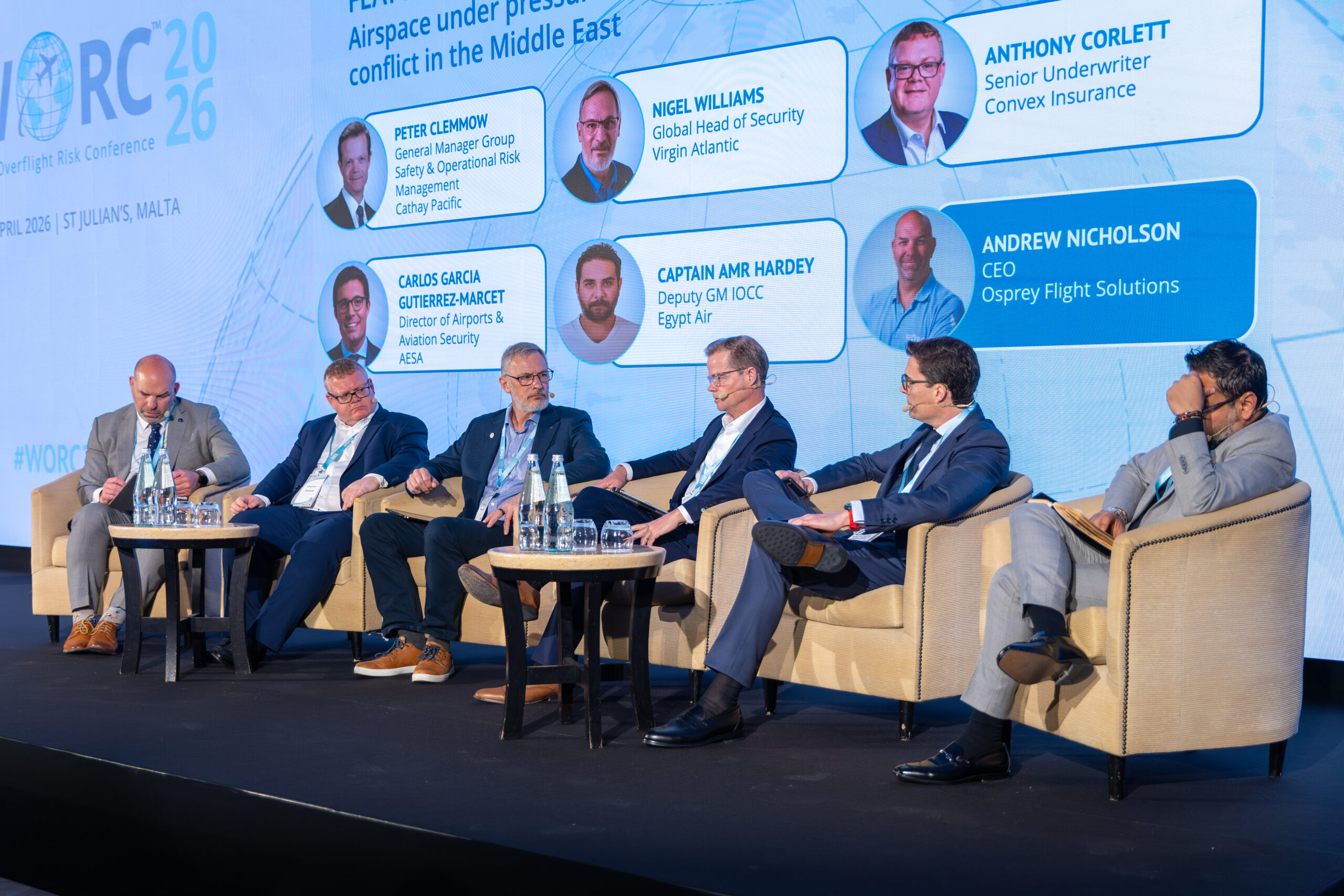
The first panel of WORC2026 did not waste time on context. Everyone in the room already had it. The question...
Geopolitical overflight risk is one of the most complex and consequential challenges in commercial aviation today. Addressing it effectively requires airlines,...
Day 2: Wednesday 22nd April 2026 Relive the best moments from day two of WORC2026
...