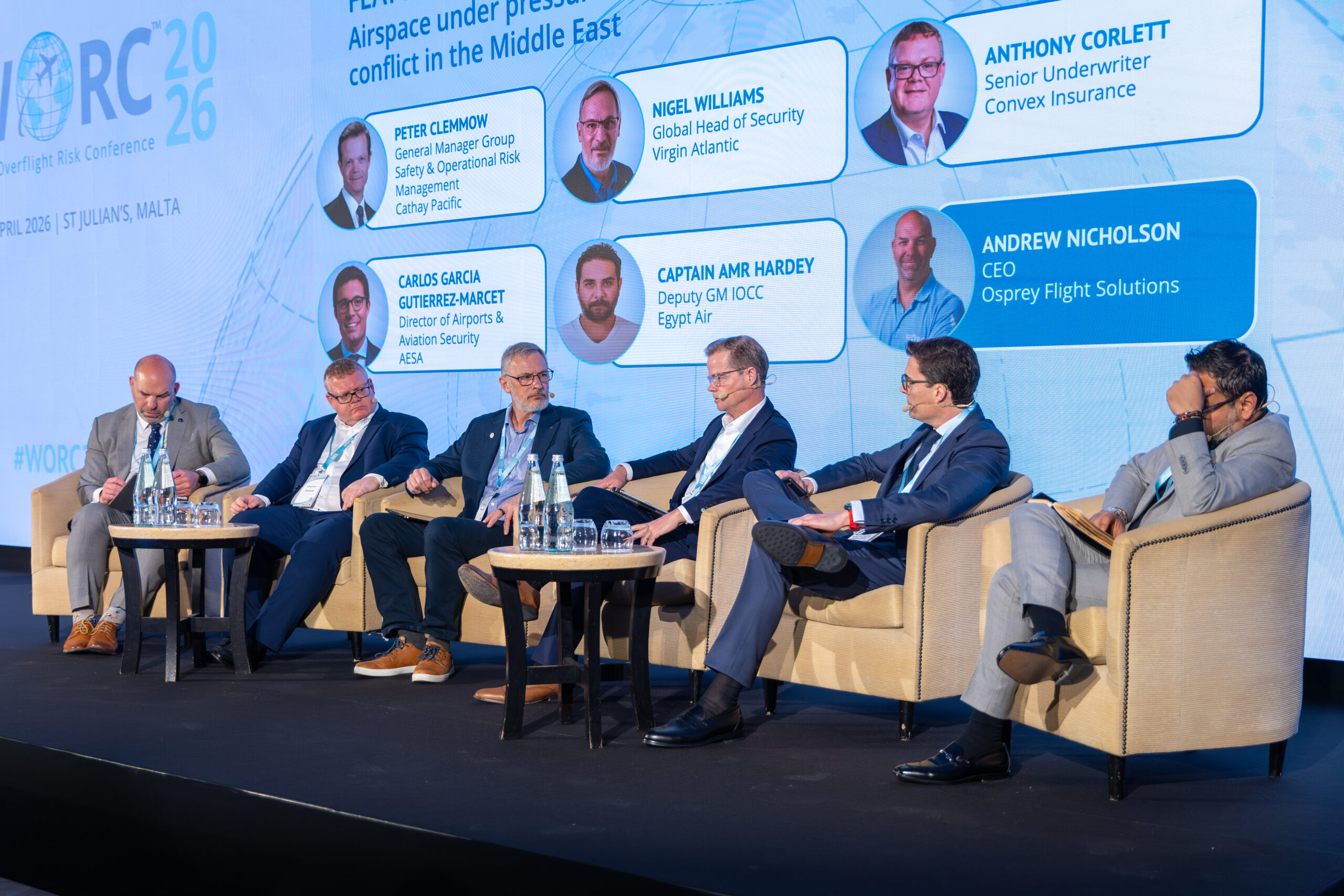
The first panel of WORC2026 did not waste time on context. Everyone in the room already had it. The question the moderator put to the panel was more direct: when the Middle East conflict escalated in February 2026, what actually made the difference between the operators that managed it well and those that did not?
The answer, repeated across five different organisations from five different operational contexts, was the same. Preparation.
Representatives from a major long-haul carrier, a major Asia-Pacific carrier, a specialist aviation insurer, a European civil aviation authority and a Middle Eastern carrier each described their experience of the conflict from a different vantage point. The airline perspectives were notably candid. Several speakers acknowledged that the moment a crisis begins is already too late to be building the frameworks, relationships and crew trust that effective decision-making requires.
The long-haul carrier’s Global Head of Security described an approach that had been years in the making. The airline’s conflict response plan had been socialised with pilots months before the February escalation, not as a theoretical exercise but as a deliberate effort to build the kind of crew confidence that would hold under operational pressure. When the situation required turning aircraft around mid-flight because safety gates had not been met, that groundwork proved decisive. The crews understood the criteria. They trusted the process. Operations were suspended and then resumed without the breakdown in confidence that less prepared operators experienced.
The contrast with organisations that had not done this work was evident in the room, even where it went unstated.
One of the more uncomfortable threads in the discussion concerned the industry’s tendency to treat other operators’ decisions as a proxy for risk assessment. If other airlines are flying, the reasoning goes, the route must be acceptable.
The panel was direct in pushing back on this. Several speakers noted that during the most acute phases of the conflict, the question of who was flying where circulated rapidly, sometimes through informal channels including messaging groups. But an operator’s decision to continue flying tells you nothing about the quality of the risk assessment behind that decision. It tells you only that the decision was made. Following without understanding is not a risk management process.
Independent assessment, grounded in objective and verifiable data, was described consistently as the differentiating factor between operators that made confident decisions and those that were reactive.
The panel also examined the relationship between commercial pressure and operational decision-making, a subject that rarely receives direct treatment in formal conference settings.
Several speakers described the internal dynamics of conflict-period decision rooms with unusual frankness. The pressure to resume operations, from commercial teams, from passengers stranded at hubs, from partners and from senior leadership, arrives early and does not let up. The operators that navigated this most effectively were those that had defined their safety gates in advance and had communicated those criteria to all relevant stakeholders before any escalation occurred.
Defining the conditions for a go decision before a crisis begins removes a significant portion of the real-time pressure. It also produces documentation that is defensible after the fact, a point the insurer’s representative on the panel made with some force.
The insurer’s contribution to the panel reframed the risk discussion in a way that landed differently for some in the room. Aviation insurance policy wordings, the panel heard, were largely designed for a world in which conflict-related airspace closures are total, clearly bounded and of reasonable duration. The Middle East conflict produced none of those conditions. Airspace closures were partial, short-term, geographically diffuse and constantly changing. The implications for how operators and underwriters understand shared risk are still being worked through.
The broader message from the insurance perspective was consistent with the rest of the panel: the time to build a relationship with your underwriter is not when you need their approval to fly. It is long before that, when you can demonstrate the quality of your risk management process in conditions that are not already critical.
The panel did not produce a formula. What it produced was a consistent account of what separates organisations that manage conflict zone risk effectively from those that do not. The difference is not access to better information in the moment, though that matters. It is the quality of the work done before the moment arrives: frameworks built, criteria defined, relationships established, crews informed and trust accumulated over time.
None of that work happens during a crisis. It happens in the periods between them.
This session took place on day one of WORC2026, held at the Corinthia Hotel, Malta, on 21 April 2026. WORC™ is co-organised by Osprey Flight Solutions, EASA, the University of Southampton and Transport Malta.
The first panel of WORC2026 did not waste time on context. Everyone in the room already had it. The question...
Geopolitical overflight risk is one of the most complex and consequential challenges in commercial aviation today. Addressing it effectively requires airlines,...

Day 2: Wednesday 22nd April 2026 Relive the best moments from day two of WORC2026
...